

The cheapest heating system – How to find the right system for your home
How do you heat a house without electricity?
Most heating systems rely on electricity in one way or another. However, more cost-effective systems can be used to make house heating cheaper. If you use a heating boiler that burns pellets, wood, or oil in your heating system, you are usually dependent on electricity for feeders and pumps to work. The heat is normally spread in the house by electric pumps circulating hot water to the house's radiators. You can reduce your electricity consumption by complementing with heating products for, for example, pellet burning.
Tile stoves and stoves usually do not require electricity to function. Therefore, they can be used as a good supplementary heating system. However, they usually cannot heat all rooms in a larger house. It is worth mentioning that with a pellet stove, you can heat up to 70% of an average-sized house. Scroll further for more suggestions on how to heat your house, while saving money every month.
In addition to tile stoves and stoves, there are also other options for electricity-free heating. A wood stove is an excellent choice and can be a self-sufficient heat source, as it does not require electricity to produce heat. A well-designed wood stove can provide efficient and long-lasting heat to different parts of your home. It is a traditional method that not only provides heat but also creates a cozy atmosphere in the room. Considering different options can help you find the most efficient and cost-effective solution to heat your house without relying on electricity.
Read more about which heating system is cheapest for your house here.
What are the different heating systems – which is the cheapest?
Below, we will go through the best heating systems for your home – but also for your wallet and the environment.
1. Pellet plant
Pellets are considered a biofuel because it is renewable and emits biogenic carbon dioxide that is not harmful to our environment. Burning with pellets is a very cheap and energy-efficient system for heating with low energy costs – gentle on both the environment and the wallet, in other words.
By switching from direct electric or oil to pellets, you can significantly lower your costs for heating and hot water. What is required is a pellet plant that is optimized for your home and your needs. Moreover, you need a pellet burner and boiler with a long lifespan. To maximize the effect of pellet burning, you can combine the plant with an accumulator tank and solar panels. Then it is possible to save up to 20% pellets per year.
In times when electricity prices are soaring, a pellet plant is a very good option for lowering heating costs – in both old and new houses. Replace your old oil boiler or wood boiler with a pellet boiler. If you have waterborne heating elements in the house, these can easily be connected to the pellet boiler. Pellets also work very well with direct electric – reduce your electricity costs by installing a pellet stove as a complement
2. Wood stove
Integrating a wood stove into your heating system is not only a sustainable and cost-effective solution, it also adds natural warmth and coziness to your home. Wood as fuel is renewable and thus contributes to reduced environmental impact. A well-selected and correctly installed wood stove can offer an efficient heat source that complements other heating systems, such as direct electric or waterborne systems.
With a wide range of wood stoves, from the smaller small stove to larger and more powerful models, there are options for every home and need. A cast iron wood stove combines aesthetics with durability and heat conductivity, making it an excellent choice for those who value both function and design.
Choosing to install a wood stove also means an investment in your home that can increase its value while creating a cozy gathering point for family and friends. Explore our wood stoves and find the perfect solution for your home by visiting our page on wood stoves.
3. District heating
District heating has a lower price per consumed kWh compared to electric heating. The price and what kind of contract can be signed vary and usually differ between different suppliers. The price also differs depending on where in the country you live.
A disadvantage with district heating is that it is not available everywhere. The connection cost can also be high, and you need to pay for the connection and installation of the district heating central unit yourself.
4. Heat pump
The heat pump takes its energy from the ground, bedrock, air, or from lake water. It reduces operating costs compared to direct electric heating, electric boiler, and oil heating. However, the investment cost is high.
There are four different types of heat pumps, all of which work differently. What mostly distinguishes them is how they get their energy (liquid or air) and how they release the energy that the pump creates (water or air).
Ground source heat pump
The ground source heat pump gathers energy from the bedrock through a deep borehole, or from buried coils in the garden. The energy can also come from a lake or groundwater. It is liquid that transports the energy to the pump which in turn delivers hot water to both taps and radiators. Unfortunately, ground heat is a very expensive investment.
Air-to-water heat pump
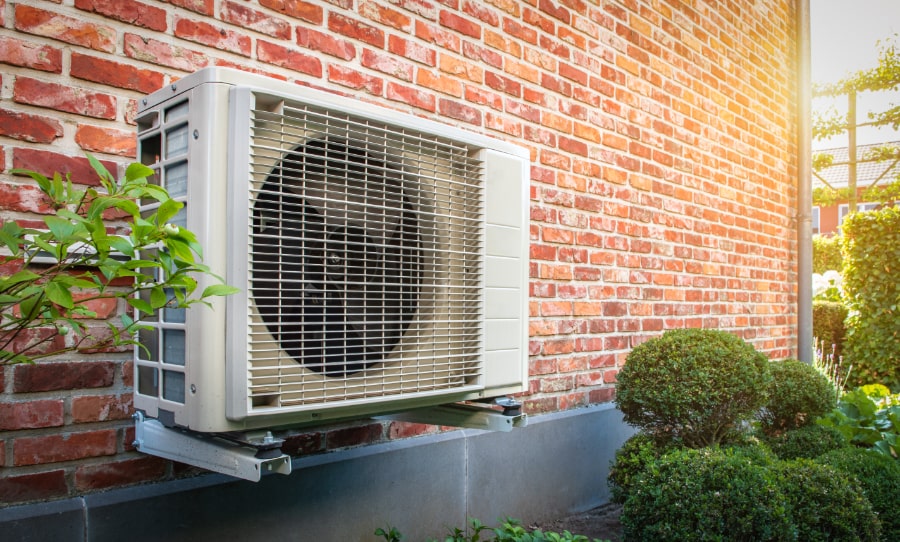
The air-to-water heat pump takes its energy from the outdoor air and transfers it to a waterborne system. The advantage of the air-to-water heat pump compared to the ground source heat pump is that it is easier to install but also cheaper than ground heat. However, it is not as energy-efficient.
Exhaust air heat pump
It is the energy in the exhaust air from the house's ventilation that the exhaust air heat pump utilizes to heat up your home. To install an exhaust air heat pump in a house, the installation of exhaust air ducts is required. The advantage of this type of pump is that your house at the same time gets a mechanical ventilation solution. However, it costs a bit to install the pump.
Air-to-air heat pump
This heat pump works as a complement to direct electric. Many air-to-air heat pumps can also cool a home and are sometimes used as AC during warm summer periods. This is the cheapest heat pump but requires some maintenance. Worth mentioning is that the pump's efficiency decreases with the outdoor temperature and it cannot be used for heating water.
6. Solar energy

The main advantage of solar energy, apart from the environmentally friendly properties, is that it can be combined with other heating sources. Solar cells that produce electricity can also drive a heat pump. Today, it is relatively economically profitable to install solar cells, compared to a few years ago. However, there are still a lot of costs involved. Solar cells are expensive to install and their batteries cost quite a bit. The production of solar energy also drastically worsens during the dark months of the year.
6. Electric heating
Electric boiler
Heating your house with waterborne heat is convenient, and the installation is not very expensive. However, electric boilers are usually not used in new constructions as they do not meet the energy performance required in new houses.
Direct electric
Electricity prices are getting higher, and therefore, it is currently expensive to heat a home with direct electric. The price for direct electric can be lowered by, for example, installing a pellet stove as a complement. You should try to reduce consumption as much as possible. If you have a high electricity consumption, it pays off to change the system to cheaper heating.
7. Gas
Natural gas is a fossil-free fuel. Other energy gases used in Sweden are town gas, propane, and biogas (not fossil-free) – even though natural gas accounts for the largest share. Gas can provide lower fuel costs than oil and electricity. However, the price for the fuel has increased a lot recently. Gas is also not available throughout the country.
Which heating system is the cheapest?
It is largely the electricity price and outdoor temperature that determine which system takes the first place. In cold weather and/or high electricity prices, a pellet boiler is the cheapest and most environmentally friendly option. To compare different scenarios, you can use our price calculator.
Pellets – a cheap option for heating your house
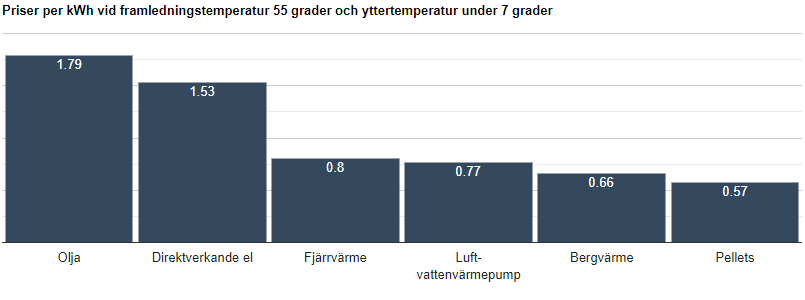
Pellets are a good fuel option for you who are looking for the cheapest heating system. If you buy pellets in large volumes, you can get the kWh price down to between 50 and 70 öre/kWh, including VAT and delivery. This can be compared with oil that costs around 1.8 kr/kWh and electricity whose price is constantly rising. Today, direct electric is the most expensive system for heating houses.
If you live in a villa with a basement and radiators, your house is not adapted for heat pumps since these work with a lower supply temperature. With a supply temperature of 55° C and an outdoor temperature of -7° C, pellet burning is today cheaper than both ground source heat and air- and water heat pumps.
Considering how expensive it is to heat a dwelling today, installing a pellet plant is a good investment – earn more money for every month that goes by.
Alternative Heat Sources without Electricity
Many people are looking for ways to reduce their dependence on electricity to heat their homes, especially in areas where power outages are common or where electricity prices are high. There are several alternative heat sources that do not require electricity, such as wood stoves, open fires, gas heaters, kerosene heaters, and solar heaters. However, these alternatives also have some drawbacks, such as high installation costs, safety risks, environmental impact, or limited availability.
An alternative heat source that is becoming increasingly popular is heat pellets. Heat pellets are small cylinders of compressed wood waste that can be burned in pellet stoves, pellet boilers, or pellet fireplaces. Heat pellets have many advantages compared to other heat sources, such as:
- Heat pellets are easy to store and handle. They come in bags or pallets that can be stacked and stored in a dry place. They take up less space than wood and are less messy than coal or oil.
- Heat pellets are efficient and clean. They have a high energy content of about 4.8 kWh/kg and a low moisture content of about 10%. They produce less ash and smoke than wood and emit fewer greenhouse gases than fossil fuels.
- Heat pellets are economical and convenient. They are cheaper than electricity, oil, or propane and can be delivered to your home or picked up at a local store. They can be automatically fed into the stove or boiler with a trough and a screw, reducing the need for manual loading and refilling.
- Heat pellets are renewable and sustainable. They are made from wood waste that would otherwise be discarded or burned. They do not contribute to deforestation or land degradation and help to reduce waste problems.
Other popular heat sources that do not require electricity are:
- Wood stoves or open fires: This is a classic and cozy way to heat your home with wood. Wood stoves or open fires provide pleasant heat and a nice atmosphere. However, you need access to wood and a chimney to release the smoke. You must also ensure that the fire is under control and that you have firefighting equipment at hand.
- Kerosene or propane heaters: These are portable heaters powered by kerosene or propane. They can provide quick and powerful heat in a smaller space. However, they require very good ventilation to avoid carbon monoxide poisoning and fire risk. You must also have enough fuel in stock and follow the safety instructions carefully.
- Bioethanol burners: These are small containers that burn bioethanol, a renewable fuel made from plants. Bioethanol burners can provide a low but steady heat in a room. They do not emit any harmful gases or odors, but they can be expensive and hard to find.
Pellet plant from Ulma
Install a pellet plant from Ulma today. Our pellet plants work excellently for heating your house. We also offer pellet stoves in a variety of designs and prices. In addition to the cost of the stove itself, there is also a cost for assembly and installation of between 10-15,000 SEK (before the ROT deduction). A small sum for a cost-effective heating system, in short.
Today we sell everything from pellet burners to pellet boilers, hot air boilers and pellet stoves, but also wood stoves and spare parts for our heating products. Do you have questions about pellet burning or our products? You are warmly welcome to contact us at +46 (0)325 - 176 80.
Related posts
 Best in class again
Event - Nordbygg 2020
Streamline your pellet burner with lambda control!
Education on Pellet heating for homeowners
Heating with pellets - frequently asked questions
Best in class again
Event - Nordbygg 2020
Streamline your pellet burner with lambda control!
Education on Pellet heating for homeowners
Heating with pellets - frequently asked questions